
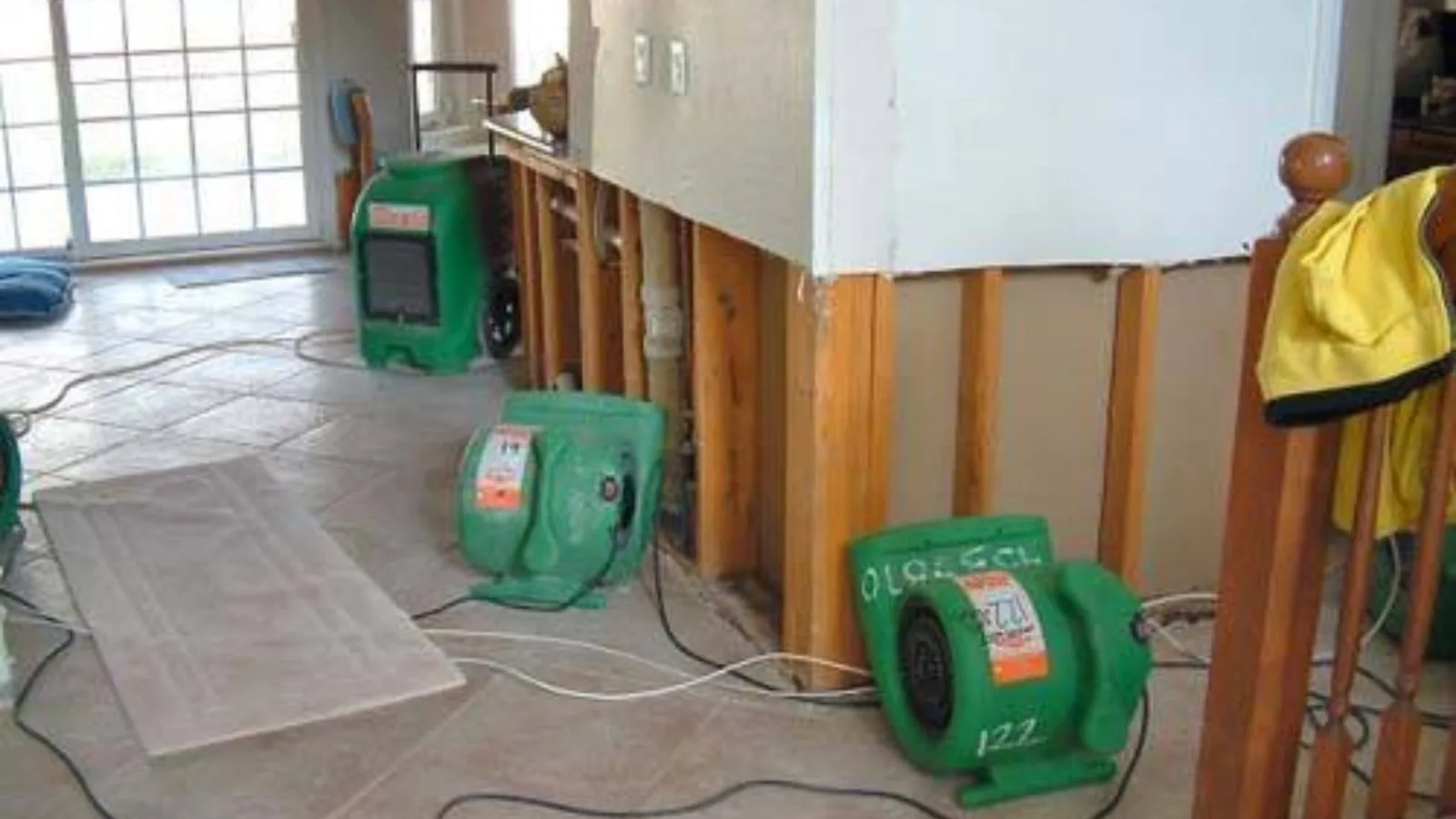
Wall and drywall water damage repair covers the removal, drying and rebuilding of drywall, baseboards, insulation and framing after a leak. Drywall has a paper face that wicks water upward and supports mold, so a wall that stays wet needs to be opened.
The 24/7 line is open any hour. While you wait, remove items from the wall, switch off power to outlets in the wet wall if the panel is dry and reachable and do not paint over the stain.
How water travels through a wall
Water rarely stays where it enters. It runs down the inside of the cavity along studs and pipes, collects at the bottom plate and wicks up the drywall like a candle wick. A stain two feet above the floor can mean the bottom six inches of the cavity is soaked.
Insulation inside the wall can hold water against the drywall, and fiberglass and cellulose lose their value when wet. Plaster, where it exists in older homes, takes longer to dry and may crack or loosen.
Signs a wall is wet
- Brown or yellow stains that grow.
- Paint that bubbles, peels or cracks.
- Drywall that feels soft or crumbles when pressed.
- Baseboards that swell or pull away.
- A musty smell near the wall base.
- Damp spots near outlets or switches.
If the stain has a ring and a faded center, the leak may have stopped and dried. A moisture meter tells you if the wall is still wet, which is worth knowing before any repair.
When drywall can be dried and when it must be cut
| Condition | Likely approach | Why |
|---|---|---|
| Clean water, caught within a day, no soft spots | Dry in place with small openings | Drywall can recover if not saturated |
| Saturated drywall or insulation | Cut out to above the wet line | Wet insulation holds moisture against the wall |
| Water stayed several days | Remove and inspect framing | Mold risk rises |
| Category 2 or 3 water | Remove below the water line | Contamination soaks into the paper and gypsum |
| Plaster walls | Dry carefully or remove | Plaster dries slowly and may fail |
The typical cut is a flood cut, a horizontal opening about 12 to 24 inches above the highest wet reading. Measurements decide where it goes.
How the repair is done
Find the source
A plumber or roofer fixes the leak. See burst pipe and ceiling water damage for common sources.
Remove wet material
Baseboards, wet insulation and saturated drywall are taken out.
Dry the cavity
Air movers and dehumidifiers dry framing until readings reach target. See structural drying.
Clean and treat
Framing is cleaned, and antimicrobial treatment is applied where the water category calls for it.
Rebuild
New insulation, drywall, tape, texture, primer, paint and trim replace what was removed.
Rebuilding before the framing is dry is the most common mistake. It traps moisture behind new drywall and shows up months later as stains or mold.
Walls in older and newer Medford homes
Medford has homes from several decades, and wall construction differs. Many mid-century homes use gypsum board over wood studs with fiberglass insulation, and some older walls use plaster or paneling.
Walls that share a plumbing run, such as behind a bathroom or kitchen, are the likeliest to be wet from a supply line. The practical step is to open the smallest area that reaches all wet material and dry from there.
Painted over or not
Painting over a damp wall seals moisture in. Do not repaint until readings reach target and the source is fixed. If the stain bleeds through new paint, the wall is still wet, or the stain-blocking primer failed. If you see black or green spots on the drywall, see the mold remediation page.
What affects the cost
Wet area
How much of the wall is wet, in height and length.
Water category
Contaminated water means removal, not drying.
Insulation and finish
Textured walls and tile backsplashes are harder to match.
Drying days
Closed cavities need time and sometimes small openings for airflow.
Rebuild
Drywall, texture and paint are priced separately.
Coverage depends on the cause, so check your policy and ask your insurer. Want your real number? Call (833) 521-1033.
Wall wet or stained?
Call the 24/7 line and describe the wall and the stain.
What to do before help arrives
- Turn off power to wet outlets and switches at the breaker, and stay away from outlets on a wet wall.
- Move furniture away from the wall and open nearby doors for airflow if the weather is dry.
- Mark the edge of the stain with a pencil and photograph it with the date.
Opening and drying a wet wall follows the ANSI/IICRC S500 standard for water damage restoration.
Wall and drywall FAQ
Do you handle wet wall emergencies at night or on weekends in Medford?
Yes. The line is available 24/7, including overnight, weekends and holidays. Call if water is running in a wall or the drywall is bulging.
Do I have to cut out the drywall?
Not always. Small, clean losses caught early can dry in place, but saturated drywall and insulation usually come out. Meters decide.
Can I paint over the stain?
Not until the wall is dry and the source is fixed. Paint hides the mark but not the moisture.
How can I tell if there is mold behind the wall?
A musty smell, dark spots and soft drywall are signs. Opening the wall is the only sure way to see, and the mold page covers the next step.
Do you cover the nearby towns?
Yes. Calls come from Holtsville, Yaphank, Patchogue, Middle Island and Blue Point.