
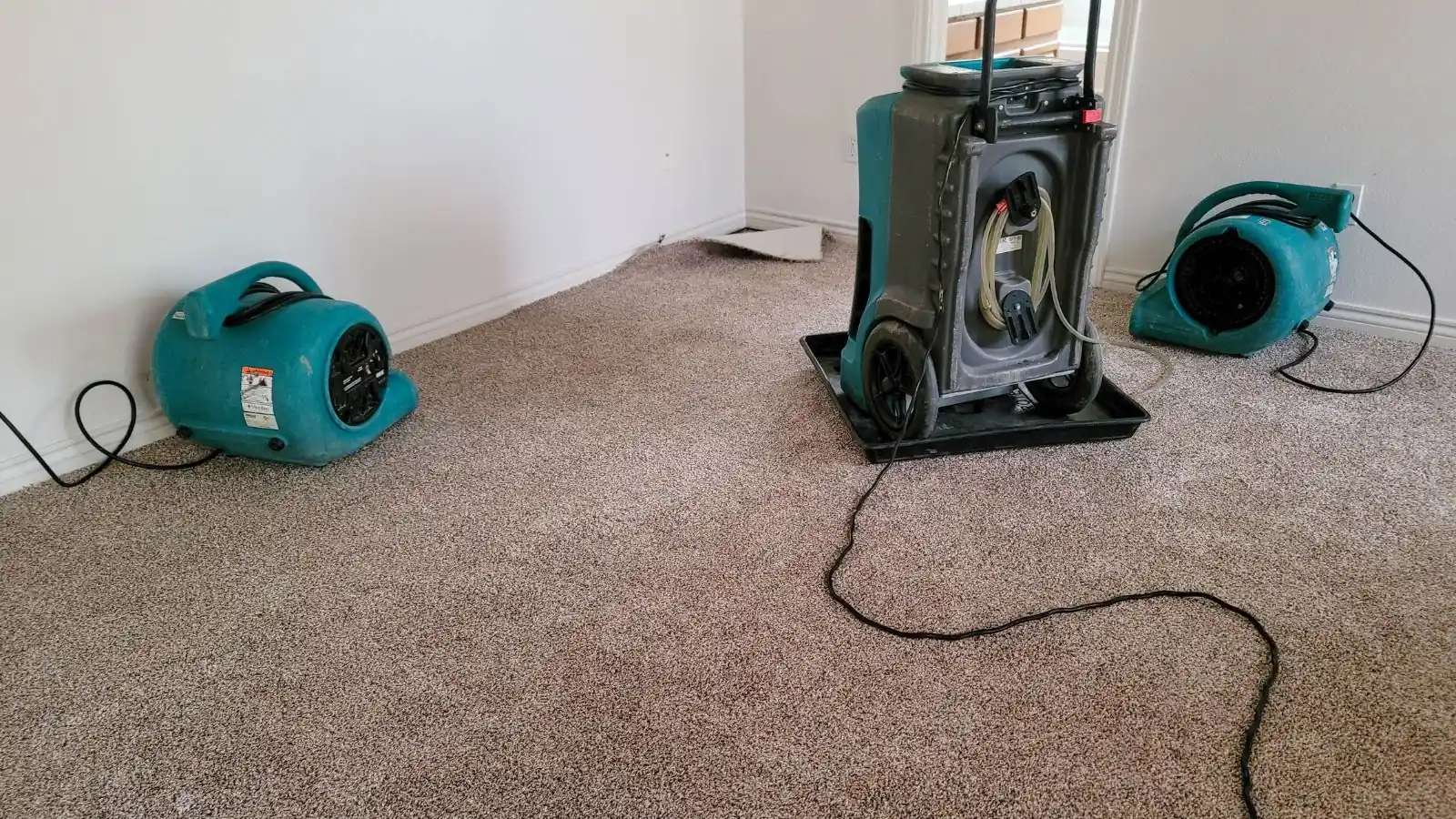
Structural drying and dehumidification is the controlled removal of moisture from a building's framing, subfloor, drywall and contents after water damage, using air movers, dehumidifiers and daily moisture readings.
It follows extraction and comes before repair, and it is the step that decides whether a leak turns into mold. The line is open 24/7, and if you are waiting, keep the heat on, open closet doors and cabinet doors and do not seal wet areas with plastic.
My walls feel damp after the water is gone
That feeling is the reason this page exists. A floor can look dry while the subfloor beneath it is wet, and a wall can feel cool and slightly clammy for days after the visible water is gone.
A musty smell, paint that bubbles and baseboards that pull away are signs that moisture is still in the structure. The trade term for the fix is structural drying, and it works by moving moisture out of the materials and removing it from the air.
If you are asking whether fans from the hardware store are enough, the answer depends on the loss. A small clean spill on tile will dry on its own. Wet wall cavities, saturated subfloor and carpet pad do not, because the water is trapped where air does not move.
How drying works
Evaporation needs three things: moving air across the wet surface, warm enough air to hold the moisture and a way to remove the water vapor. Air movers supply the airflow. Dehumidifiers pull vapor out of the air so the surfaces can keep releasing moisture. Together they dry the structure faster than either one alone.
Low-grain-refrigerant (LGR) dehumidifiers are the standard equipment for most water losses, because they remove more moisture at the humidity levels found in wet buildings. In cold or very wet conditions, desiccant dehumidifiers can be used. Air movers are placed so the air strikes wet surfaces at an angle and does not just blow across a room.
Moisture mapping and the drying log
Drying is guided by measurements. Moisture meters read the moisture content of wood, drywall and concrete. Thermal imaging shows cold, wet areas behind surfaces. Hygrometers record temperature and humidity so the room conditions stay in a range that dries the structure.
| What is measured | With what | Why it matters |
|---|---|---|
| Moisture content of wood and drywall | Pin and pinless meters | Shows whether the material has reached its dry standard |
| Hidden wet areas | Thermal camera | Finds water behind walls and under floors |
| Room humidity and temperature | Hygrometer | Keeps conditions in a drying range |
| Day-to-day progress | Daily readings at the same spots | Shows the trend and when to stop |
Readings are taken daily from the same points. Drying is complete when each material reaches a dry reading, set by a dry reference in the same building, and not when it simply looks or feels dry. Ask for the log. It is also what your insurer will want to see.
Water mitigation
Water mitigation is the term used for the first-phase actions that stop damage from growing: extraction, moving contents, removing materials that cannot be dried and setting up drying equipment. It is the same as the early steps described here and on the water extraction page. Mitigation limits the loss, and restoration repairs and rebuilds afterward.
How long drying takes
There is no honest single number. Drying depends on the material, the water category, how long it was wet, humidity and temperature, and how much equipment is used. Thin drywall may dry in a few days, while hardwood, plaster and a slab can take longer. Equipment is moved or removed as areas reach target, and the log records it.
For a loss that began with a floor, the hardwood floor and carpet pages explain how those surfaces are dried or replaced. If the loss reached framing and insulation inside a wall, see the wall and drywall page.
Drying in a Medford home
Long Island's humid summers make drying harder, because the air outside is already holding moisture, and a house with the windows open will fight the equipment. Winter air is dry but cold, and cold surfaces dry slowly. In both seasons the practical rule is the same: keep the space closed while equipment runs, keep the thermostat steady and do not turn the dehumidifiers off early because the room feels fine.
What affects the cost
Area and volume
The number of wet rooms and cubic feet sets how much equipment is needed.
Materials
Thick or dense materials dry more slowly than thin ones.
Water category
Contaminated water changes what has to be removed rather than dried.
Drying days
Equipment is billed by days in place, so conditions that slow drying add cost.
Monitoring
Daily readings add time but prevent drying too little or too long.
Insurers often ask for drying logs and photos, so ask for them at the start. Coverage depends on the cause of the loss and the policy. Want your real number? Call (833) 521-1033.
Water gone but the damp remains?
Call the 24/7 line and ask how drying is verified.
Monitoring and drying goals here follow the ANSI/IICRC S500 standard for water damage restoration.
Structural drying FAQ
How do I know if the walls are still wet when they feel dry?
Moisture meters and thermal imaging can see wet material behind a surface that feels dry. Ask for readings from the same spots over several days.
Do you handle drying emergencies at night or on weekends in Medford?
Yes. The line is available 24/7, including overnight, weekends and holidays, and starting the equipment early limits how much of the structure stays wet.
Will drying prevent mold?
It lowers the risk, because mold needs moisture. It does not mean mold can never appear, and the mold remediation page explains what to do if you see growth.
Can I rent a dehumidifier and do it myself?
For a minor spill, yes. For wall cavities, subfloor and larger losses, professional equipment and monitoring are needed to reach a verified dry standard.
Do you serve Holtsville, Yaphank and other nearby towns?
Yes. The line covers Medford and Holtsville, Yaphank, Patchogue, Middle Island and Blue Point.