
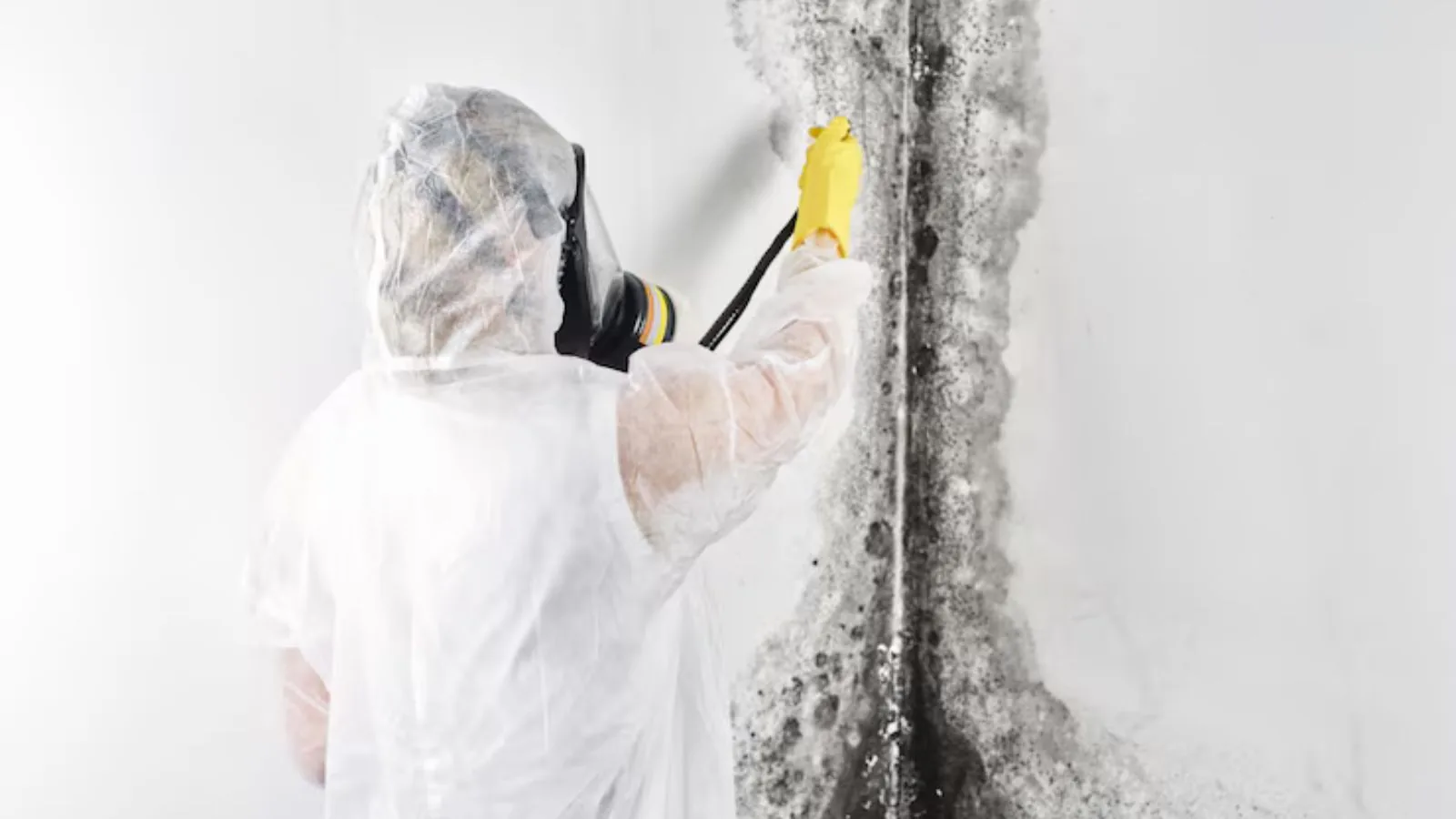
Mold remediation is the containment, removal and cleaning of mold growth after a moisture problem, followed by a check that the area is clean. It is a secondary service here, because mold almost always follows a water loss that was not dried in time.
The line is open 24/7 for the water side of the problem. Mold needs moisture to grow, so if you see growth, stop the source of the water first, keep the area closed off and do not disturb it by sanding, scrubbing dry or blowing air across it.
There is a musty smell and dark spots on the wall
Most people reach this page without knowing the trade term. They have a musty smell, dark or fuzzy spots on drywall, a ceiling stain that has turned green or black or a wall that was wet last month. The word for the fix is mold remediation, and the first question is not how to kill it but why it is there.
Mold grows on damp organic material such as drywall paper, wood and carpet pad. It needs moisture that lasts for days. Without fixing the water source and drying the material, removal alone only buys time. For a recent leak, drying may be enough. For growth that is already visible, remediation is the next step.
Mold and moisture
Mold spores are in the air everywhere, and they settle on surfaces. They grow when a surface stays damp for days, with the exact timing depending on temperature and the material. That is why this site's main work is extraction and drying. The structural drying page explains how materials are brought down to a dry standard, which is the strongest defense against growth.
Health questions about mold, including any symptoms in your household, belong to a physician. This page does not give medical advice, and it does not claim that any particular mold is harmful.
What the S520 standard covers
ANSI/IICRC S520 is the published industry standard for professional mold remediation. It covers assessment, containment, removal, cleaning and verification. You can ask any company whether its crews work to it. The standard describes conditions, not a promise: it does not say mold will never return.
| Step | What it involves |
|---|---|
| Find and fix the moisture source | A plumber or roofer stops the leak and drying begins |
| Assess the extent | Visual inspection and moisture readings show how far growth goes |
| Contain the area | Plastic sheeting and negative air keep spores from spreading |
| Remove contaminated material | Affected drywall, insulation or pad is cut out and bagged |
| Clean | HEPA vacuuming and damp wiping of framing and surfaces |
| Dry and verify | Moisture readings confirm the area is dry, and a post-remediation check follows |
New York State's mold program
New York regulates mold work through the New York State Department of Labor's mold program, which requires licenses for mold assessors and remediation contractors and sets work standards.
Under the program, the person who assesses a mold project may not also perform the remediation on it, an independent assessment defines the scope, and a post-remediation assessment follows. Homeowners working on their own property are a limited exception. Ask any mold company for its New York license and read the department's page before you hire.
This means the sequence for a mold project in Medford is usually an assessment, then a remediation plan, then removal, then a clearance assessment. The cleanup of the water damage that caused it can proceed alongside, and the line can help with that side.
When mold is small and when it is not
| Situation | Common approach |
|---|---|
| A small spot on a hard surface after a minor spill | Clean the surface and fix the moisture |
| Growth on drywall, carpet or insulation | Material is removed in containment |
| Growth over a large area or in an HVAC system | Professional assessment and remediation |
| Water damage older than a few days with a musty smell | Check inside the wall before it spreads |
| Sewage or floodwater involved | Contamination plan first, mold second |
Bleach is not a recommended fix for porous materials. It does not reach roots inside drywall or wood and adds moisture. The approach that follows the standard is to remove contaminated porous material and clean the rest.
Where mold shows up after a Medford leak
The usual spots are inside walls behind a bathroom or kitchen, under carpet in a basement, in attic insulation below a roof leak and in a closet near an air handler.
If your loss began with a leak, the page for that source explains the water side, such as the wall and drywall and basement water damage pages. The AC leak page covers condensate leaks that feed growth in closets and attics.
What affects the cost
Area affected
The square footage of growth and the surrounding material.
Materials
Drywall and insulation are removed, while framing is cleaned.
Containment needs
Larger projects need more sheeting, air filtration and protective gear.
Assessment and clearance
Independent assessment and post-remediation checks are separate services.
Rebuild
New drywall, paint and finishes follow clearance.
Coverage for mold depends on the policy and the cause, and many policies limit it, so ask your insurer. Want your real number? Call (833) 521-1033.
Mold after a leak?
Call the line and describe where you see it and where the water came from.
The ANSI/IICRC S520 standard covers professional mold remediation, and New York licensing rules apply on top of it.
Mold remediation FAQ
Why does my house smell musty after a leak even though I cannot see mold?
A musty smell can mean moisture is trapped in a wall or under flooring. A moisture reading and an opening in the wall show what is there.
Do you handle water emergencies that cause mold at night or on weekends in Medford?
Yes. The line is available 24/7 for the water damage that leads to mold. Stopping the water and drying quickly is the first step.
Do I need testing?
Testing is a separate assessment. New York's program uses an independent assessor to define the scope, so ask for that before remediation on a project.
Will mold come back after remediation?
Remediation removes growth and a clearance check confirms the area is clean. It does not prevent regrowth if moisture returns, so the water source must stay fixed.
Does a mold company need a license in New York?
The state's mold program licenses assessors and remediators. Check the Department of Labor page and ask any company for its license.
Do you serve homes outside Medford?
Yes. Calls come from Holtsville, Yaphank, Patchogue, Middle Island and Blue Point.