
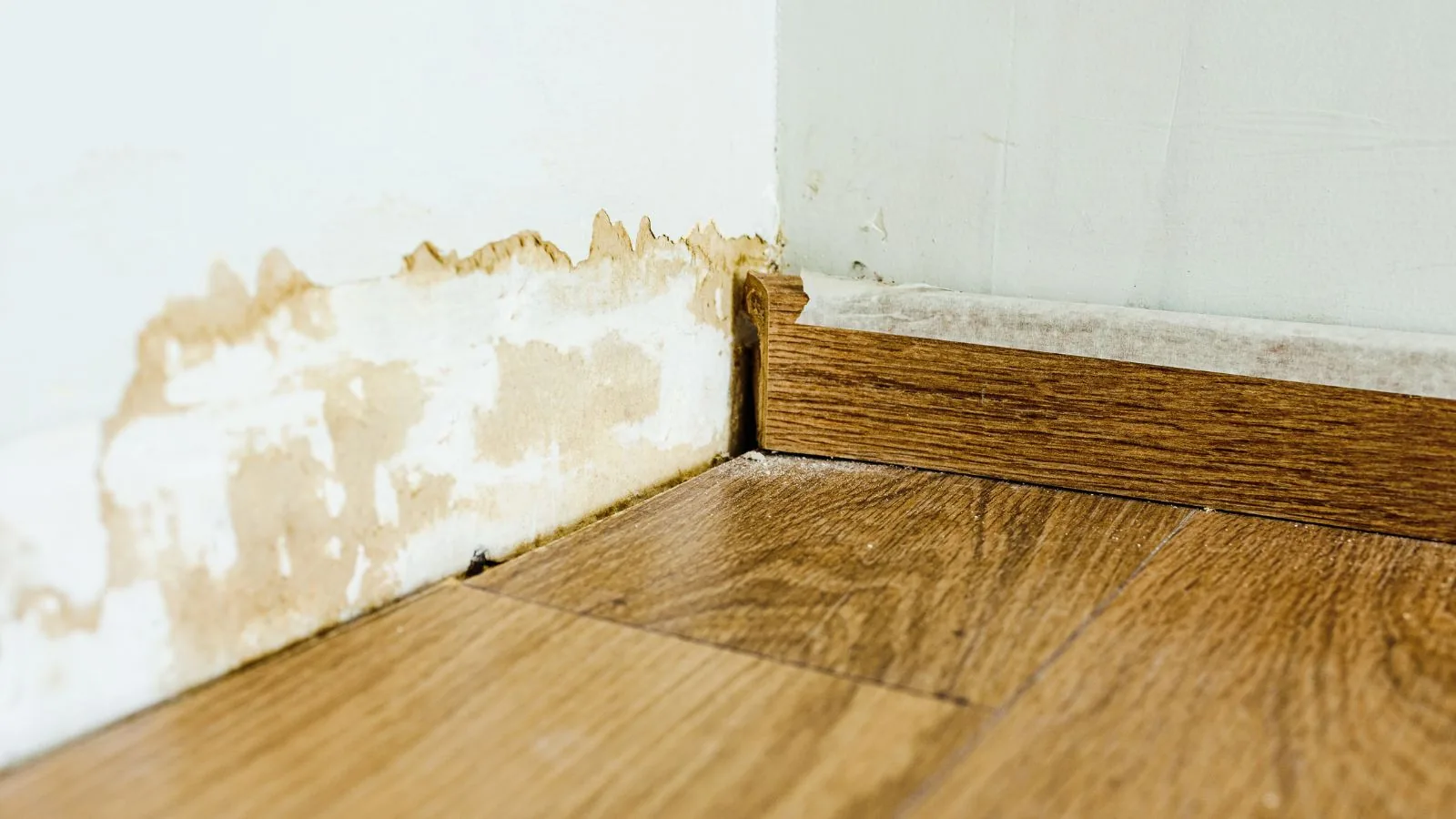
Whether to file a claim for a small water leak depends on your policy, the cause of the water, your deductible and how much damage is really there. This guide does not tell you what to do, because it cannot see your policy. It lays out what to weigh, what to document whatever you decide and where a small leak can turn out to be bigger than it looks.
First, deal with the water
A claim decision can wait a few hours. Wet materials cannot. Stop the source, remove standing water and start drying, and take photos before and during the work. Most policies expect the homeowner to take reasonable steps to prevent further damage, and emergency drying is usually one of them. Keep receipts for anything you pay for.
What to weigh
| Question | Why it matters |
|---|---|
| What caused the water? | Sudden events such as a burst pipe are treated differently from long-term seepage or neglect |
| What is your deductible? | If repairs are close to or under it, a claim may not pay out |
| Is there hidden damage? | Wet insulation or a wall cavity can make a small stain a larger loss |
| Could a claim affect renewal? | Ask your agent how claims are recorded and how they may affect your policy |
| Is the damage still growing? | Ongoing moisture or mold raises the stakes |
Each of these is a question for your insurer or agent, not for a restoration company. The point of the table is that a small visible stain can hide a larger problem, so look before deciding that it is not worth a claim.
Small leaks that are not small
A leak that looks minor can be the visible edge of something larger. A stain on a ceiling can mean a saturated cavity above it, and the ceiling water damage page explains how that is checked. A damp patch on a wall can mean water inside the wall, covered on the wall and drywall page. A slow supply leak can run for weeks before it shows.
A moisture meter or thermal camera tells you how far the water went. That reading is useful for a claim decision, because it shows whether the loss is a spot or a section. A technician can take it without any commitment to repairs, and an insurer will often ask for documentation like it.
What to document either way
The New York State Department of Financial Services advises homeowners to document damage with photos, keep receipts for emergency repairs and provide an inventory of damaged items. Do that even if you decide not to file, because you may change your mind when the repair turns out to be bigger. A record made on day one is easy to produce later, and one made from memory is not.
Keep the failed part if a pipe or fitting broke, and write down the date and time you noticed the water, what you did and who you called.
Ask before you decide
Call your agent or insurer and ask general questions. You can ask how the policy treats the type of water you had, what the deductible is and how reporting works. Ask what the insurer needs from you to review a loss. You are entitled to understand the process before you commit to it, and a question is not the same as a claim, although you should ask how your insurer records inquiries.
A Medford note on common sources
Medford has many single-family homes of different ages, and small leaks commonly come from supply lines, water heaters, appliance hoses, roof and window openings and condensate lines. In the Town of Brookhaven, which includes Medford, storms and freezing weather bring their own roof and pipe losses, and each has a different insurance treatment.
If the water entered from outside through flooding or groundwater, check the policy carefully, because flood is commonly handled separately from ordinary homeowner coverage. Your insurer can tell you which applies, and the DFS publishes consumer guidance on flood and homeowner claims.
Related pages cover common sources, such as the water heater leak and appliance leak pages. The same questions come up in Yaphank and Middle Island.
A short decision list
- Stop and photograph the water before anything else.
- Get readings to learn how far it went.
- Read your policy or call your agent with general questions.
- Compare the likely repair with the deductible.
- Keep every receipt and record whatever you decide.
Small leak claim FAQ
Should I always file a claim for a leak?
Not always. It depends on your policy, the cause, the deductible and the damage. Ask your insurer general questions first.
Can I wait to see if the leak gets worse?
Waiting lets water spread and can raise the risk of mold. Dry the area and document it now, and decide on the claim with readings in hand.
Do I need a restoration company to file?
No. The claim is between you and your insurer. A company can provide documentation of what it found and did.
What if I decide not to file and the damage grows?
Your earlier photos and receipts will help if you file later. Ask your insurer about any reporting deadlines.
Is groundwater or flood water treated the same?
Often not. Flood is commonly handled separately from ordinary homeowner coverage, so check your policy.